A few weeks ago, a parishioner gave me a gift for my birthday.
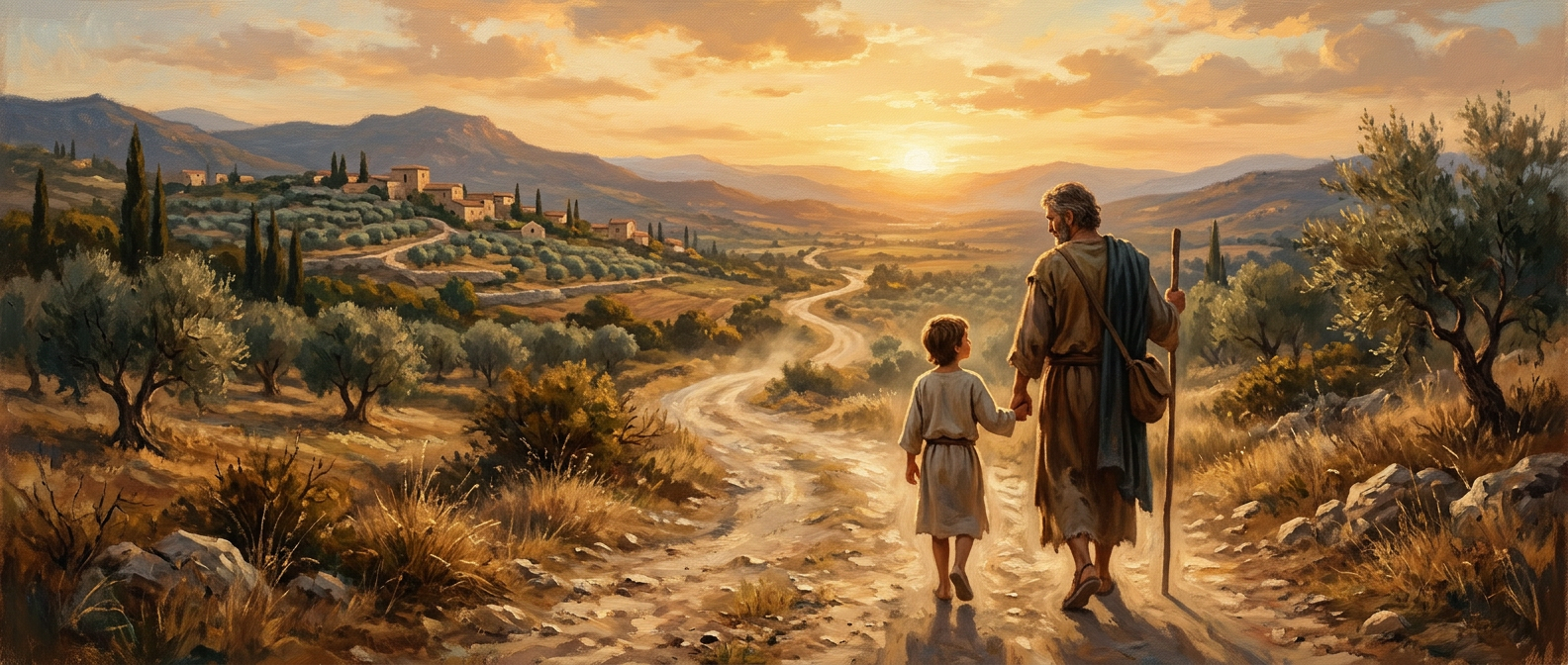
It's a small, handmade banner. The image shows Saint Joseph walking down a road, holding the hand of a young Jesus. Three simple words: Go to Joseph.
It hangs where I see it every morning now, in our chapel in the basement where I pray for an hour every day before the family wakes up. And it's a daily edification I didn't realize I needed.
"Go to Joseph." The phrase comes from Genesis.
During the great famine in Egypt, the people cried out to Pharaoh for food. His response: "Go to Joseph and do whatever he tells you."
As steward, the Joseph of Genesis had stored up grain during the years of plenty. When the famine came, he was the one who could provide. The whole world came to him.
The Church has long applied those words to a different Joseph - the carpenter from Nazareth who became the guardian of the Holy Family. St. Teresa of Avila was famous for telling everyone she knew to "go to Joseph." She wrote that she never asked him for anything he didn't grant, and she couldn't understand why everyone wasn't devoted to him.
Pius XII made it explicit in 1955 when he instituted the feast of St. Joseph the Worker: "If you want to be close to Christ, I repeat to you - Ite ad Ioseph: Go to Joseph!"
I've prayed to St. Joseph before work for years. A quick prayer in the car, asking for his intercession over the day ahead.
But something has shifted.
The work I'm asking him to bless isn't just the day job anymore. It's what I'm building in the margins - Domus Formation, the writing, the formation work that might one day become something more than margins.
And suddenly, "Go to Joseph" carries different weight.
Because Joseph knows something about building in the margins.
Think about his life. He was given the most important assignment in human history: Protect the Son of God, provide for the Holy Family, help form the boy who would save the world.
And he did it in complete hiddenness.
No public ministry. No recorded words in Scripture. No crowds, no miracles, no recognition. Just faithfulness in a small town, in a carpenter's shop, day after day.
He never saw how the story turned out. He died before Jesus began His public ministry. He planted seeds he would never see bloom.
Pope Francis, in Patris Corde, called him "a father in the shadows." He wrote: "St. Joseph reminds us that those who appear hidden or in the shadows can play an incomparable role in the history of salvation."
That's the patron I need right now. Maybe it's the patron you need too.
There's something else in that image on the banner: Joseph walking, holding Jesus's hand.
Not standing at the destination, but walking. The journey - the dailiness of it.
Joseph formed the Holy Family not through dramatic moments but through presence. Through showing up. Through the rhythms of work and prayer and meals and rest, repeated across years.
That's what I'm trying to build with Domus - formation for the domestic church. And Joseph keeps reminding me that the father's role in that formation isn't a program or a curriculum. It's presence. It's walking alongside.
He's also reminding me that formation looks different for the husband and father than it does for the wife and mother. Not better or worse - different. Joseph led his family, but he led by walking with them. He protected, provided, and formed - mostly in silence, mostly through dailiness, mostly through being there.
That's the vision I keep coming back to. That's what Joseph models.
His feast day as husband to Mary is March 19 - two days from now. And then again on May 1, the feast of St. Joseph the Worker.
Two feast days for one saint. The Church doesn't do that casually.
The March feast celebrates Joseph as spouse of Mary, guardian of Jesus, patron of the universal Church. The May feast celebrates him as the carpenter, the worker, the one who shows us that labor offered to God becomes holy.
Both feasts, both dimensions - the family man and the working man - are exactly what I need right now.
So every morning as I get to the chapel, I see that banner. Joseph walking. Jesus at his side. Go to Joseph.
And I do.
I ask him to bless the work - both the work that pays the bills and the work I'm building in the margins.
I ask him to teach me how to lead my family the way he led his - through presence, through dailiness, through showing up.
I ask him to help me trust the seeds I'm planting, even when I can't see how they'll grow.
And I ask him to pray for everyone doing the same - every husband and father trying to lead a domestic church, every person building something in the margins, every worker offering their labor to God.
Ite ad Ioseph. Go to Joseph.
He knows the way.
O Glorious Saint Joseph, model of all those who are devoted to labor, obtain for me the grace to work in a spirit of penance for the expiation of my many sins; to work conscientiously, putting the call of duty above my natural inclinations; to work with thankfulness and joy, considering it an honour to employ and develop by means of labor the gifts received from God; to work with order, peace, moderation and patience, never shrinking from weariness and trials; to work above all with purity of intention and detachment from self, keeping unceasingly before my eyes death and the account that I must give of time lost, talents unused, good omitted, and vain complacency in success, so fatal to the work of God.
All for Jesus, all through Mary, all after thy example, O Patriarch, Saint Joseph. Such shall be my watch-word in life and in death. Amen.
– Composed by Pope St. Pius X
If this resonated with you, I'd be honored if you shared it with someone who might need to hear it.
Comments
Sign in to leave a comment.